


Your operating costs are skyrocketing. You lack visibility into your vehicles. Your drivers don't always follow procedures. If you manage a fleet of vehicles, these problems cost you money, time, and performance every day. Fleet management is no longer optional; it's a strategic imperative. In this guide, discover the four pillars that enable top-performing fleet managers to optimize their fleet, reduce expenses, and improve driver safety.
Why fleet management is essential today
Managing a vehicle fleet means constantly juggling multiple constraints: fuel costs, preventative maintenance, regulatory compliance, driver safety, and customer satisfaction. Without the right tools, every decision is based on incomplete or outdated data.
However, the stakes are considerable. Fuel represents one of the biggest expenses for a vehicle fleet. Inefficient use alone can throw an annual budget off balance. Added to this are unexpected breakdowns, accidents, fines for non-compliance, and lost productivity for field teams.
Companies that have adopted a connected and structured fleet management system are achieving measurable results: fewer accidents, lower fuel consumption, improved customer relations, and reduced insurance costs. This isn't theory; it's what real-world data shows.
The digital transformation of fleet management does not eliminate problems. It gives you the means to anticipate them.
The 4 pillars of effective fleet management
Pillar 1: Real-time vehicle tracking
GPS fleet tracking involves placing receivers in each vehicle to continuously transmit data to your management system. The result: complete visibility of your entire fleet, wherever it is located.
In practical terms, this allows you to:
- Detect delays and risky driving behavior
- Monitor individual driver performance
- Optimize routes to reduce fuel consumption and idling time
- Manage service hours in accordance with regulations
For companies managing hundreds or thousands of vehicles across multiple geographic areas, GPS tracking becomes essential. It centralizes all assets on a single platform and allows for real-time responses to unforeseen events.
Good fleet management software does more than just locate vehicles. It analyzes data, generates automatic alerts for sudden braking, speeding, and vehicles left idle for too long, and helps you make better decisions every day.
Pillar 2: Fuel Consumption Control
Fuel is the number one expense in most vehicle fleets. Poor management is costly, often without the company even realizing it.
Consumption monitoring tools allow you to:
- Identify the most energy-inefficient vehicles
- Detect aggressive driving behaviors (sudden acceleration, prolonged idling)
- Prevent fuel theft
- Rewarding drivers who adopt eco-driving practices
- Limit CO₂ emissions
The monitoring methods include telematics sensors installed on the fuel line. These devices measure the incoming volume, engine temperature, and operating time. The data is transmitted in real time to the fleet management system, enabling precise cost planning.
Daily consumption reports give managers a clear picture of what is happening on the ground, and driver coaching tools do the rest.
Pillar 3: Compliance, safety and adherence to procedures
Regardless of the size of your company, your fleet must comply with all applicable regulations: maintenance standards, fuel taxes, hours of service regulations, accident management.
Fleet management software helps you keep these records automatically and measure each driver's compliance as part of their professional evaluation.
Safety is inextricably linked to compliance. On-board diagnostics monitor the health of vehicles in real time and send alerts as soon as a problem is detected, before a minor fault becomes a major incident. They also help reduce the risk of accidents and compensation costs.
Without strong and consistent policies, it is impossible to expect a high level of voluntary compliance. Problems often arise because drivers are unaware of the rules. A good fleet management system makes these rules visible, measurable, and enforceable.
Pillar 4: Telematics and data in the service of performance
Telematics is the backbone of modern fleet management. It connects vehicles, drivers, and the company's information systems to create a unified and actionable view in real time.
A standalone telematics unit installed on each vehicle allows for:
- Reduce collisions by 20 to 30 (source: Risk Management and Insurance Agency)
- Gain complete visibility into vehicle activity
- Reduce insurance costs through driving data
- Maintain maintenance schedules and anticipate breakdowns
- Integrate the data into your internal tools (CRM, inventory management, ERP)
Telematics does more than just collect data; it transforms it into decisions. Managers can adjust routes, identify high-risk drivers, and optimize the lifecycle of each vehicle.
How to reduce the costs of your car fleet
Reducing fleet costs isn't just about negotiating better purchasing terms. The most significant gains lie in day-to-day operational optimization.
Here are the most effective levers to optimize your vehicle fleet:
IoT sensors and proactive maintenance. Sensors installed on vehicles monitor tire pressure, fuel consumption, and engine temperature. They alert managers before breakdowns occur. The result: fewer unexpected downtimes and lower emergency repair costs. UPS's case is a prime example: by equipping 200 trucks with sensors in 2010, the company was able to maintain its vehicles based on actual usage rather than fixed schedules disconnected from real-world conditions.
GPS tracking and route optimization. A GPS tracking system automates planning, reduces unnecessary mileage, and allows teams to focus their efforts on high-value tasks. Fuel and labor are the two largest cost items for a fleet; GPS addresses both simultaneously.
SIM card and connected data management. A SIM card dedicated to your fleet, combined with an online management platform, allows you to balance data consumption per vehicle and optimize connectivity costs according to your actual usage.
Onboard telematics and reduced insurance premiums. Telematics data allows insurers to better assess the true risk of your fleet. Managers who demonstrate a history of safe driving receive lower premiums. Telematics also helps prevent fraud, recover stolen vehicles, and expedite claims processing.
Why telematics is revolutionizing fleet management
Telematics is no longer a niche technology reserved for large transport companies. Today, it is accessible to any company managing a vehicle fleet, regardless of its size.
What fundamentally changes with telematics is the shift from reactive to predictive management. Previously, you discovered problems after they occurred. With fleet management software equipped with telematics, you anticipate them.
The generated data allows us to:
- Identifying high-risk drivers before an accident occurs
- Schedule preventive maintenance based on the actual wear and tear on the vehicles
- Reduce idling time and energy-intensive behaviors
- Improving customer satisfaction through on-time deliveries and optimized routes
- Guiding the transition to eco-driving with objective data
Fleet management software thus becomes the beating heart of your operations. It aggregates data, makes it readable and actionable, without spreadsheets, manual entry, or blind spots.
Customer focus is also a major issue in fleet management. On-time delivery, better-supervised drivers, reliable deliveries: on-board telematics has become a key element of customer service strategies in many transport companies.
Download our white paper
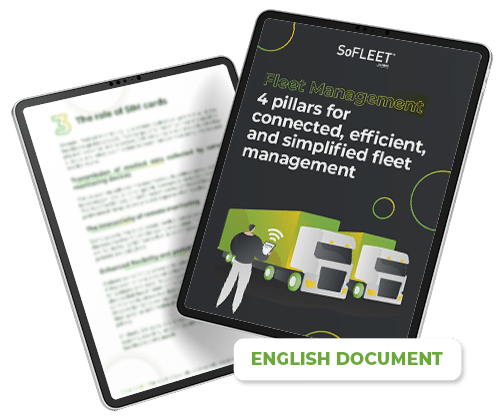
4 pillars for connected, efficient and simplified fleet management.
What is fleet management?
Fleet management encompasses all the processes involved in supervising, optimizing, and controlling a fleet of company vehicles. It includes GPS tracking, vehicle diagnostics, fuel consumption management, regulatory compliance, and driver management. Fleet management software centralizes all this data in real time on a single platform.
Which fleet management software should I choose?
The right software must match the size and specific needs of your fleet. Essential criteria include: real-time GPS tracking, automatic maintenance alerts, advanced diagnostic functions, compatibility with your internal tools (CRM, ERP), mobile accessibility, and scalability. Opt for a cloud-hosted SaaS solution accessible from any device, with a trial period limited to a few vehicles.
GPS fleet tracking optimizes routes, reduces idling time, and helps identify fuel-inefficient driving behaviors. It automates planning, frees up time for high-value tasks, and can generate significant savings on fuel and labor—the two largest expenses for a fleet.
Is telematics suitable for small fleets?
Yes. Modern telematics solutions are available as SaaS, without requiring significant hardware investment. With as few as 5 to 10 vehicles, the benefits are measurable: reduced insurance costs, improved traceability, preventative maintenance, and driver coaching. The scalability of the platforms allows you to start small and grow with your fleet.
How to optimize fuel consumption for a fleet of vehicles?
Several combined levers are effective: installing telematics sensors to measure real-time consumption, analyzing driving reports to identify energy-intensive behaviors, implementing eco-driving programs for drivers, optimizing routes via GPS, and planning preventive maintenance to avoid overconsumption related to mechanical wear.


How can GPS tracking reduce my fleet costs?